

Operations Consulting with a Fundraiser’s EYE
Chaos is expensive.
What is it costing you?
Operations consulting with a fundraiser’s eye.
Chaos is expensive. What is it costing you?
OPERATIONS WITH A FUNDRAISER’S EYE
Chaos is expensive. What is it costing you?
Does this sound Familiar?
Does this sound Familiar?
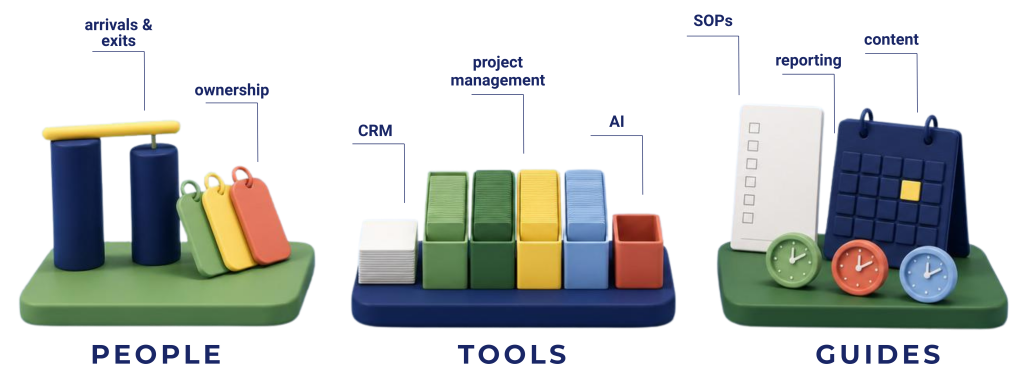
THE INFRASTRUCTURE.
When people ask what we do, the honest answer is operations, and that word covers so much ground it tells you almost nothing. So we mapped it out. These nine systems are what we work on, grouped three ways. We have found that it is also the fastest way for someone to find themselves, because most people already know which square has been giving them trouble.
THE FRAMEWORK DEFINED.
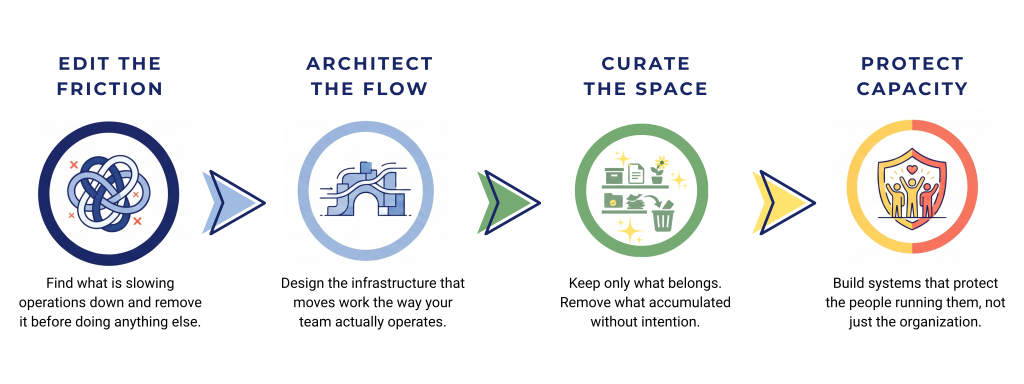
Edit the friction
Find what is slowing operations down and remove it before doing anything else.
architect the flow
Design the infrastructure that moves work the way your team actually operates.
CURATE THE SPACE
Keep only what belongs. Remove what accumulated without intention or what no longer serves.
protect capacity
Build systems that protect the people running them, not just the organization depending on them.
Our Editor-Architect Framework.
Four moves created with lots and lots of trial and error. Almost every operations engagement in this sector starts at the second move, because building looks like progress and cutting looks like nothing happened, so the new database goes in on top of the old mess, the mess comes along with it, and eighteen months later somebody decides the database never worked. We edit first because we spent years watching it happen the other way and seeing fundraising suffer.
Who HAs Trusted Our Work.
Who HAs Trusted Our Work.
Why a fundraiser built an operations firm.
Most organizations call us after something slips. A campaign stalls, a key person leaves, or the same problem keeps showing up in a different meeting. Before anything gets rebuilt, we spend time on how the work actually moves through your organization, because the distance between how it runs and how everyone believes it runs is where the cost lives.
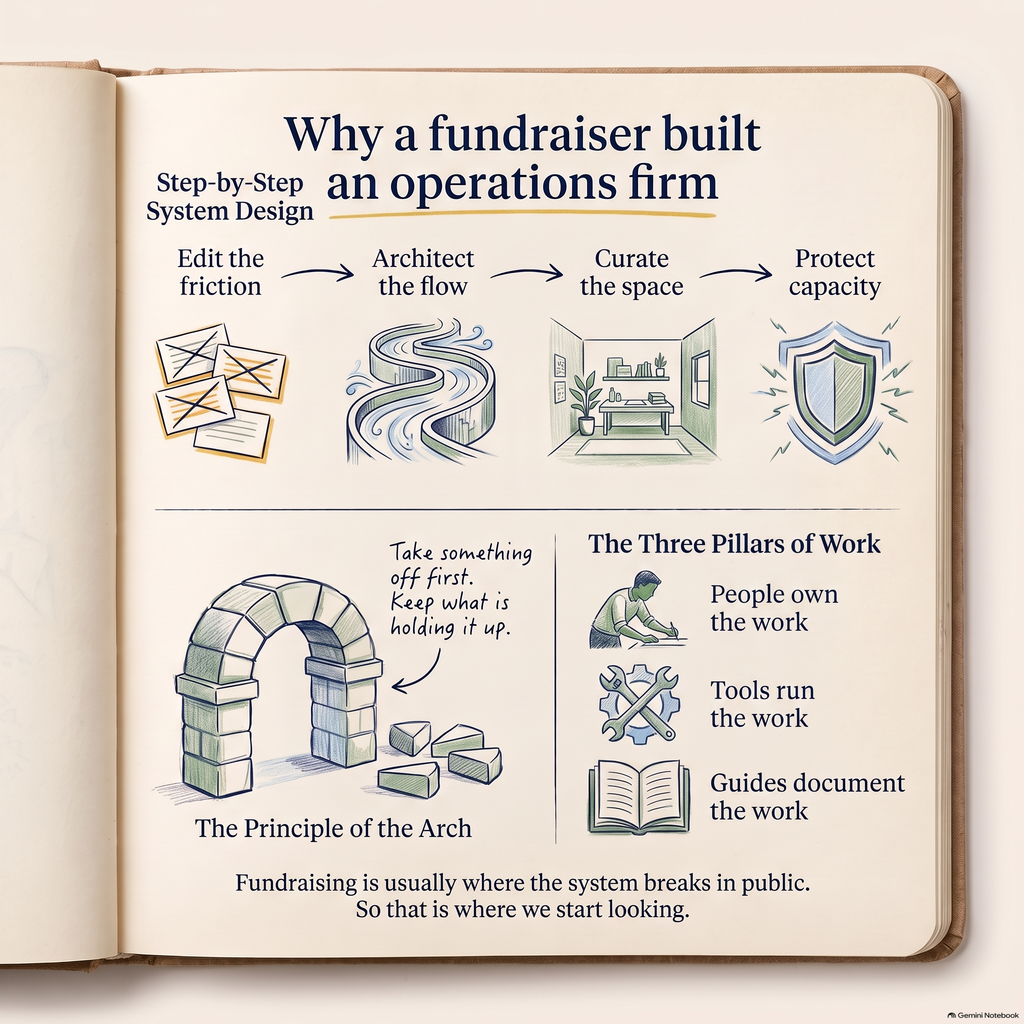
Our method is to edit the friction, architect the flow, curate the space, and protect capacity, in that order. Editing comes first because the fastest way to give a team its capacity back is to take something off of it, and that requires knowing which processes are holding the organization up and which ones are left over from a year nobody remembers.
After nearly three decades in the fundraiser’s chair, we have seen where operational strain shows up first. It shows up in the donor who did not get thanked, the gift that sat unprocessed, and the report nobody trusts enough to act on. Fundraising is usually where the system breaks in public, so that is where we start looking.
So every engagement ends with people who own the work, tools that run it, and guides that document it. Your team keeps all of it when we leave.
Why a fundraiser built an operations firm.
Most organizations call us after something slips. A campaign stalls, a key person leaves, or the same problem keeps showing up in a different meeting. Before anything gets rebuilt, we spend time on how the work actually moves through your organization, because the distance between how it runs and how everyone believes it runs is where the cost lives.
Our method is to edit the friction, architect the flow, curate the space, and protect capacity, in that order. Editing comes first because the fastest way to give a team its capacity back is to take something off of it, and that requires knowing which processes are holding the organization up and which ones are left over from a year nobody remembers.
After nearly three decades in the fundraiser’s chair, we have seen where operational strain shows up first. It shows up in the donor who did not get thanked, the gift that sat unprocessed, and the report nobody trusts enough to act on. Fundraising is usually where the system breaks in public, so that is where we start looking.
So every engagement ends with people who own the work, tools that run it, and guides that document it. Your team keeps all of it when we leave.
FEATURED THINKING
WHERE YOU CAN FIND US.



Most operational friction is invisible until someone looks at it differently.
The Clarity Lens gives you five diagnostic lenses for examining any system, process, or workflow inside your organization. Download your copy and see where the friction lives.